How Ace & Tate's responsibility report earns credibility by admitting failure
Most corporate responsibility reports never admit that anything went wrong. The format was designed for projecting confident progress: a metric improves, a chart goes up, a target gets restated. So when Ace & Tate's 2020 Responsibility Report reaches slide 20 — titled, plainly, "Bad moves and lessons learned" — and explains that the company's earlier 2030 net-zero target was unrealistic and has been revised to 2050, the slide is doing something almost no peer report does. It's why the rest of the document is worth taking seriously.
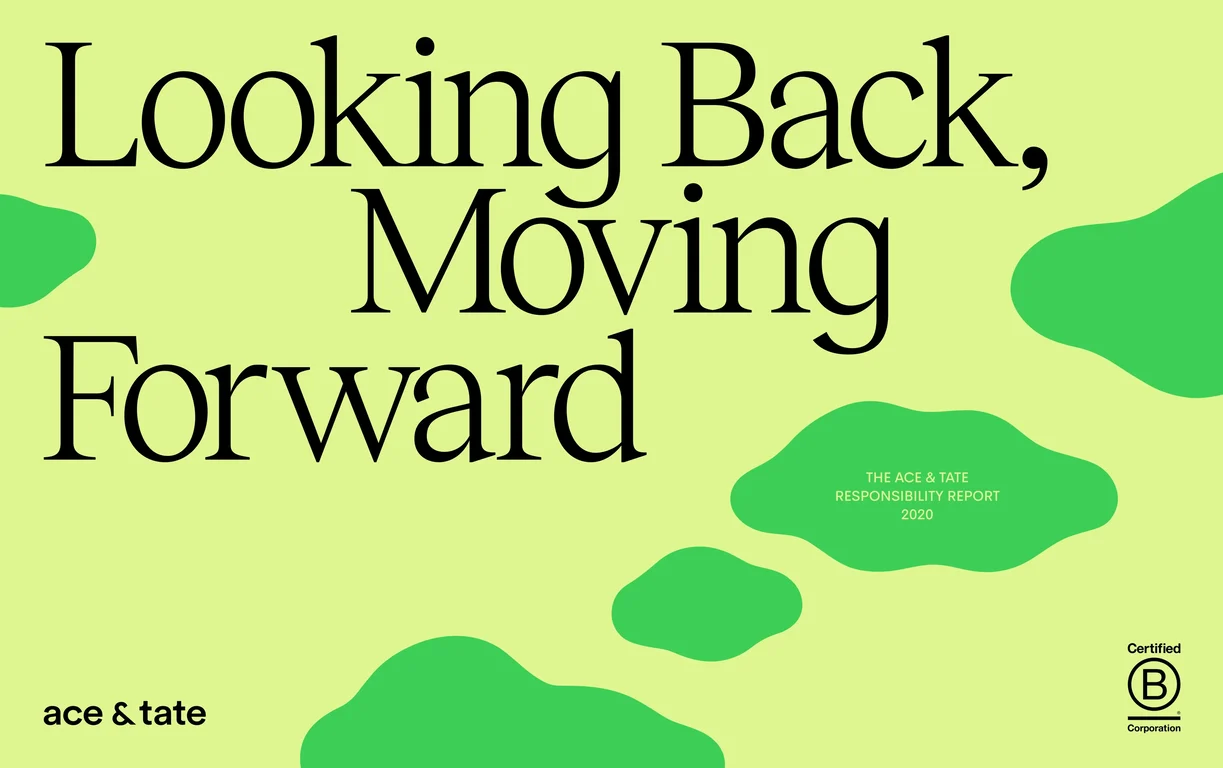
Ace & Tate is a Dutch direct-to-consumer eyewear brand, B Corp certified in 2020. The report's title — "Looking Back, Moving Forward" — is the editorial frame. The "looking back" half is what most ESG reports skip.
The structure of the 49 slides
The report uses a four-chapter framework: Planet, Products, People, Progress. Each chapter follows the same pattern — a section divider, an overview, three to five evidence slides, and a forward-looking recommendations page. That repetition is intentional. It tells the reader what page they're on without re-reading the chapter title.
The opening twelve slides are framing: founder letter (slides 2–5), table of contents, mission, year in review, the four-pillar diagram (slide 11), and a methodology slide explaining ISO 14040/14044 lifecycle assessment, Science Based Targets, and B Corp alignment (slide 13). After that, each of the four chapters runs roughly seven slides, ending with a forward-looking page.
The pattern is rigid; the content varies.
What works
The founder letter is four slides, not one
Slides 2 through 5 are all signed by founder Mark de Lange. Most responsibility reports run a half-page founder note before getting to the data. Ace & Tate spends four pages letting the founder set up the report — including, on slide 5, a candid section on early environmental missteps the company is still correcting.
The four-page founder voice does two things. It signals that the report is something the founder personally read and stands behind, not a marketing artifact. And it establishes the report's tone — we got things wrong; here is what we got right since then — before any chart shows up. Once that tone is set, every later metric is read inside it.
The methodology slide names the standards out loud
Slide 13 names ISO 14040 and 14044, B Corp, the Science Based Targets initiative, and the UN Sustainable Development Goals. That is not unusual on its own — most reports cite at least one — but the slide commits to all of them simultaneously, in advance, before the data slides start. The reader knows by page 13 what frameworks the rest of the report will be measured against, and any reader who knows those standards can cross-check the report against them later.
This is the methodological version of putting the answer first. Don't make the reader hunt for which protocol you followed. Name it on a single slide and move on.
Slide 20 is the report's load-bearing page
Slide 20: Bad moves and lessons learned does three things in one page. First, it admits the original 2030 net-zero target was unrealistic. Second, it explains the new 2050 target is set with the Science Based Targets initiative — meaning a third party validates the new number. Third, it lists corrective actions: renewable energy, offset partnerships, supplier changes.
The structural lesson here is asymmetric. A report that admits one mistake credibly is read more generously on every other claim. A report that admits no mistakes is read with default skepticism on every claim. Ace & Tate trades a single page of vulnerability for a credibility dividend that compounds across the other 48 pages.
Each chapter ends with a "forward priorities" slide
Every chapter closes with a recommendations page — Planet's, Products', People's, and Progress'. These pages are short. They don't restate the chapter; they list the next year's commitments.
Most responsibility reports either bury commitments in the back of the document or never write them out, which makes the next year's report unable to be measured against the previous one. By writing commitments at the end of each chapter, the report becomes auditable in a year — anyone reading the 2021 report can flip to slide 21 of the 2020 report and ask whether the listed actions happened.
What to consider
Some chapter overviews repeat the chapter divider
Each chapter opens with a section-divider slide (e.g. Chapter Four: Progress) and then an overview slide with similar content (e.g. Progress: goals and targets). The divider plus the overview produces some redundancy. For a 49-slide document, a single chapter intro that combines the title and a one-line preview might tighten the read without losing structure.
People is the chapter most at risk of softness
Where the Planet chapter is grounded in measurable emissions data, and Products is grounded in lifecycle assessment, the People chapter leans more on commitments and less on numbers. The slides on diversity, fair wages, and supply chain transparency describe approach more than they report numbers. That's likely a function of 2020 reporting maturity — most consumer brands didn't yet have audited social-data programs — but it's the chapter that will need to evolve fastest to maintain the credibility the rest of the report earns.
The 2050 target is harder to hold someone accountable to
Moving net-zero from 2030 to 2050 is an honest revision, but 2050 is also far enough away that no current executive will be in their role to be measured against it. The interim targets — 2025, 2030, 2040 — become the load-bearing accountability dates. The report would be stronger if the interim targets were more prominent than the headline 2050 number, since those are the ones that will actually matter to a reader in 2026 or 2030.
Takeaway
The interesting page in this report is slide 20. Everything before it sets up the admission, and everything after it gets read inside the credibility that admission earns. If you're writing a responsibility or annual report, the structural lesson is that admitting one specific failure with a specific replacement plan is worth more credibility than fifty slides of progress claims.
Most reports won't take that trade. The ones that do — like Ace & Tate's — get read with the benefit of the doubt on every other page, which is the entire point of a responsibility report in the first place.
Read next: the Linear sales deck breakdown, which makes a different version of the same move (refusing to dedicate slides to features the company hasn't earned), or browse other reports in the gallery.